



"Better to have too much than too little."
It's a familiar approach across the foodservice industry. When the alternative is a stockout during a busy trading period, maintaining additional inventory can feel like the sensible decision.
But across an enterprise restaurant estate, that approach comes at a significant cost.
What starts as a small safety margin at store level can quickly become a much larger challenge for demand planning, food distribution (FD) and supply chain operations.
Excess inventory doesn't simply increase the risk of food waste. It ties up working capital, distorts demand signals, creates unnecessary pressure on distribution networks and makes it harder for operators to maintain an efficient, responsive supply chain.
For enterprise hospitality businesses, the challenge isn't simply reducing the quantity of stock being ordered.
It's ensuring that demand, inventory, procurement and distribution are working from the same information.
The Compounding Effect of Over-Ordering Across an Enterprise Estate
At an individual restaurant, ordering an additional case of product might seem insignificant.
Across hundreds or thousands of locations, however, those decisions compound.
Consider a quick-service restaurant (QSR) brand operating 1,000 locations, each applying a modest buffer to its weekly orders.
Individually, those buffers might appear reasonable. Collectively, they can create substantial excess demand throughout the distribution network.
Distributors may respond by increasing stockholding. Procurement teams may adjust purchasing volumes. Manufacturers may interpret inflated orders as genuine consumer demand.
The result is a supply chain responding to demand that doesn't necessarily exist.
This is closely related to the bullwhip effect, where relatively small changes in downstream demand create increasingly significant fluctuations further upstream.
For enterprise operators, the consequences can include:
- Increased inventory holding costs across stores and distribution centres
- Greater working capital requirements throughout the supply chain
- Additional warehouse capacity and handling requirements
- Inefficient procurement and replenishment decisions
- Increased exposure to short-dated and obsolete inventory
- Reduced accuracy in demand and supply planning
- Greater operational complexity across distribution networks
Without consistent visibility across the supply chain, each participant may introduce additional safety stock to compensate for uncertainty elsewhere.
The Difference Between Consumer Demand and Order Demand
One of the most important distinctions in enterprise food distribution is the difference between what customers actually consume and what restaurants order.
These figures are not necessarily the same.
A restaurant might order additional stock because it anticipates a busy weekend, has experienced previous supply disruption or simply wants to maintain a comfortable inventory buffer.
That order represents a purchasing decision, not necessarily an accurate reflection of underlying consumer demand.
When distributors use historical order volumes as the primary input for replenishment planning, these behaviours can become embedded in future forecasts.
Over time, the gap between actual consumption and supply chain demand can widen.
This is particularly problematic for products with limited shelf life, variable lead times or complex distribution requirements.
For enterprise foodservice businesses, accurate demand planning requires visibility beyond purchase orders.
Point-of-sale (POS) transactions, menu-level consumption, inventory positions, product availability and promotional activity all contribute to a more complete understanding of demand.
By connecting these signals, operators and distributors can distinguish between genuine changes in customer consumption and ordering behaviour driven by uncertainty.
Why Traditional Replenishment Models Struggle at Scale
Many foodservice supply chains still rely heavily on historical averages, fixed PAR levels and established ordering patterns.
These approaches provide consistency, but they can struggle to accommodate the complexity of modern multi-site operations.
Demand varies significantly between locations, even within the same brand.
A city-centre restaurant may experience strong weekday lunchtime demand, while a suburban location may generate higher volumes during evenings and weekends.
Local events, weather conditions, promotional campaigns and changes in customer behaviour introduce further variability.
For distributors, this creates a difficult planning environment.
Inventory must be positioned appropriately across distribution centres, transport capacity must be allocated, and supplier lead times must be managed while maintaining service levels.
When demand signals are inaccurate or delayed, distributors are often forced to compensate through additional inventory.
The result is a replenishment model that protects availability through excess stock rather than improved demand visibility.
At enterprise scale, this is both expensive and difficult to sustain.
Connecting Store Demand With Food Distribution
Reducing unnecessary inventory requires closer alignment between restaurant operations and the wider food distribution network.
This starts with improving the quality and availability of demand data.
Rather than relying exclusively on historical orders, enterprise operators can use consumption-led forecasting to generate a more accurate picture of expected requirements.
These forecasts can then inform store replenishment, distributor inventory planning and upstream procurement decisions.
The objective is to create a connected planning process in which each part of the supply chain has visibility of the demand it needs to fulfil.
For example, a change in expected demand across a regional group of restaurants should be reflected in the requirements communicated to the relevant distribution centre.
Likewise, supplier constraints, available inventory and delivery schedules should inform what stores can realistically order and receive.
This requires more than simply connecting systems through integrations.
It requires consistent product data, agreed ordering rules, reliable inventory information and clear processes for managing exceptions.
When these elements work together, businesses can reduce the need for defensive stockholding at multiple points in the supply chain.
The Role of Big Data in Connecting the Food Supply Chain
For enterprise foodservice operators, one of the biggest barriers to effective demand planning isn't a lack of data. It's that valuable information is spread across multiple systems, organisations and stages of the supply chain.
POS transactions, store inventory, purchase orders, distributor stock positions, delivery information and supplier data all provide part of the picture.
Individually, these datasets have value. Connected, they can provide a much clearer understanding of how consumer demand translates into supply chain requirements.
This is where Orderly's Big Data Model becomes particularly important.
Rather than treating store operations, distribution and supply chain planning as separate activities, the model provides a framework for bringing together information from across the foodservice ecosystem.
The objective is to connect the point of consumption with the decisions being made further upstream.
When a restaurant experiences a change in sales demand, that information has implications beyond its next replenishment order.
It can influence distributor demand forecasts, inventory allocation, procurement requirements and ultimately production planning.
By connecting these data points, enterprise operators can move from a fragmented view of individual transactions towards a more complete understanding of supply chain performance.
From reactive ordering to connected intelligence
The real value of a Big Data Model isn't simply collecting more information. It's making that information useful.
With a connected data foundation, businesses can better understand the relationship between actual consumption, forecast demand, ordering behaviour and inventory availability.
This creates opportunities to identify where excess inventory is building up, where demand signals are being distorted and where replenishment decisions could be improved.
It also establishes a stronger foundation for advanced analytics, machine learning and AI-driven forecasting.
Instead of relying exclusively on historical purchase orders, businesses can develop a more detailed understanding of the factors influencing demand across their estate.
For enterprise food distribution, this represents an important shift.
Rather than each part of the supply chain making decisions based on its own limited view, connected data can support more informed planning across stores, distributors and suppliers.
Ultimately, reducing the cost of 'just in case' ordering depends on reducing uncertainty.
And reducing uncertainty starts with connecting the data that already exists across the supply chain.
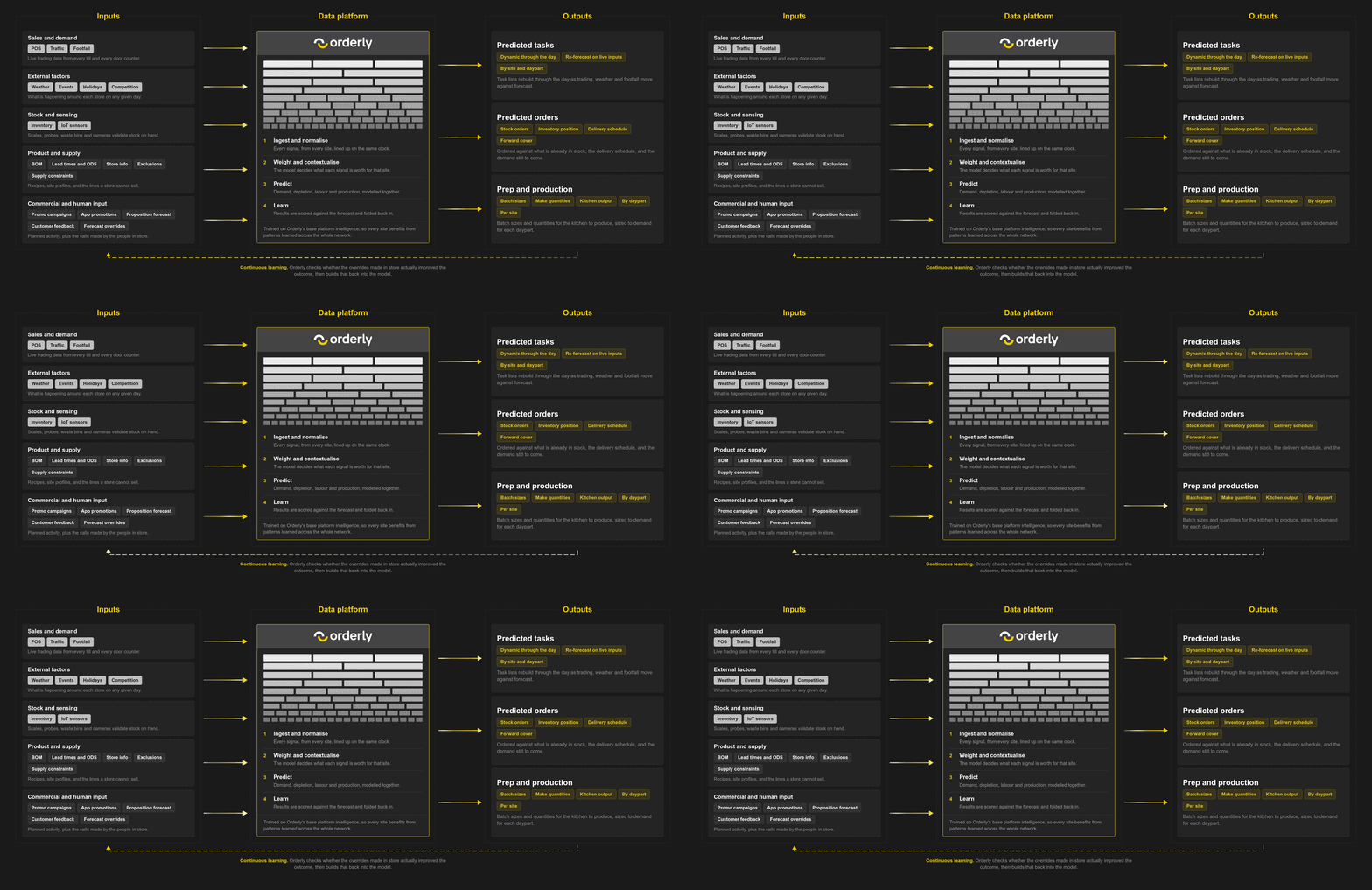
Orderly's Big Data Model: Connecting operational data across the foodservice ecosystem to support more informed demand planning, inventory management and supply chain decisions.
Moving Towards Demand-Driven Replenishment
Demand-driven replenishment changes the relationship between forecasting and ordering.
Instead of treating forecasting as a separate analytical exercise, it becomes an operational input into purchasing and distribution decisions.
For enterprise foodservice operators, this involves several connected capabilities.
Consumption-led demand forecasting
Using POS data, product recipes, historical consumption and relevant external factors to estimate future ingredient requirements at store level.
Inventory-aware ordering
Considering existing stock, stock in transit, delivery frequency, product shelf life and operational constraints before calculating replenishment requirements.
Distributor inventory visibility
Providing greater insight into stock availability, expected demand and potential supply constraints across the distribution network.
Automated order recommendations
Generating replenishment recommendations using forecast demand, inventory positions and agreed business rules, while allowing operational teams to manage exceptions.
Exception-based management
Identifying unusual demand patterns, potential stockouts, excessive inventory and supply disruptions so teams can focus their attention where intervention is required.
Together, these capabilities help enterprises move away from static replenishment models towards a more responsive, data-led approach.
Importantly, automation doesn't remove the need for human judgement.
It allows experienced supply chain and operational teams to spend less time processing routine transactions and more time managing the exceptions that genuinely require their attention.
The Commercial Impact of Better Demand Alignment
The financial implications of excess inventory extend well beyond the cost of discarded food.
For enterprise operators, improving demand alignment can influence several important performance measures.
Inventory turns and working capital
Reducing unnecessary stockholding can release capital and improve inventory efficiency across both stores and distribution centres.
Waste and product write-offs
More accurate replenishment decisions can reduce the volume of perishable inventory reaching the end of its usable life.
On-shelf availability and service levels
Better demand visibility can help businesses protect product availability without relying on excessive safety stock.
Distribution efficiency
More predictable replenishment requirements can support improved warehouse planning, transport utilisation and delivery scheduling.
Forecast accuracy and bias
Understanding the difference between predicted demand and actual consumption helps businesses identify systematic over-forecasting or under-forecasting.
Supplier collaboration
More reliable demand signals can improve planning conversations between restaurant brands, distributors and manufacturers.
These measures should not be viewed independently.
Reducing inventory at the expense of availability is unlikely to deliver a sustainable improvement.
Equally, achieving excellent availability through consistently excessive stockholding can conceal significant inefficiencies.
The objective is to optimise the relationship between service levels, inventory investment and operational cost.
Why Enterprise Visibility Matters
One of the greatest challenges for large hospitality businesses is that responsibility for inventory is often distributed across multiple organisations.
Restaurant operators manage store-level stock. Distributors manage warehouse inventory, fulfilment and deliveries. Suppliers manage production and procurement.
Each organisation has its own systems, processes and performance measures.
Without a connected view of demand and inventory, optimisation often happens in isolation.
A store may reduce its inventory while unintentionally transferring additional pressure to its distributor.
A distributor may increase safety stock to protect service levels without understanding whether the underlying demand is genuine.
A manufacturer may adjust production based on order fluctuations that originate from defensive purchasing behaviour rather than changes in consumer consumption.
Enterprise supply chain optimisation requires visibility across these boundaries.
This is where connected store and distributor technology becomes particularly important.
At Orderly, our approach brings together store operations and food distribution through Orderly for Stores (OFS) and Orderly for Distributors (OFD).
By connecting operational data and processes across these environments, businesses can improve the flow of information between the point of consumption and the wider distribution network.
The goal is to support better decisions throughout the supply chain, rather than simply optimising individual processes in isolation.
AI Can Improve Forecasting, But Data Foundations Still Matter
Artificial intelligence is creating new opportunities for enterprise demand forecasting and supply chain optimisation.
Machine learning models can help identify complex patterns in historical consumption, promotional activity, seasonality and external demand drivers.
But AI alone cannot resolve the underlying problems created by fragmented data.
If product master data is inconsistent, inventory records are unreliable or POS information cannot be connected to distributor product catalogues, even sophisticated forecasting models will struggle to deliver dependable recommendations.
For enterprise operators, the priority should be establishing reliable data foundations and connecting the systems responsible for forecasting, ordering and fulfilment.
AI can then become a practical part of the operational workflow, rather than another disconnected source of predictions.
The value comes from translating better forecasts into better purchasing, replenishment and distribution decisions.
Rethinking 'Just in Case' Across the Supply Chain
Safety stock will always have a role in food distribution.
Supplier disruption, unexpected demand and operational variability mean that maintaining some inventory protection is both necessary and commercially sensible.
The question is whether that protection is calculated using a realistic understanding of demand and supply risk, or simply inherited from historical ordering habits.
For enterprise foodservice businesses, this distinction matters.
When every restaurant, distributor and supplier adds its own buffer, the collective cost can become substantial.
But when demand signals are connected, inventory positions are visible and replenishment decisions are informed by reliable data, businesses can manage uncertainty more intelligently.
That creates an opportunity to reduce unnecessary stockholding, improve working capital efficiency and minimise waste without compromising customer availability.
The Bottom Line
Over-ordering isn't just a restaurant-level problem.
It's an enterprise supply chain challenge that affects demand planning, procurement, distribution, working capital and sustainability.
The solution isn't simply asking stores to order less or distributors to hold less stock.
It's creating a more connected, demand-driven supply chain where inventory decisions reflect actual consumption, operational requirements and supply constraints.
And that starts with connecting the data, systems and organisations responsible for moving food through the supply chain.
Because in modern food distribution, the objective shouldn't be to hold as much stock as possible 'just in case'.
It should be to have the right inventory, in the right place, at the right time, with the confidence that the wider supply chain can deliver.

.svg)






.svg)

.svg)
.svg)