



We keep having the same conversation with operations leaders. A global restaurant chain or convenience retailer sits across the table and says the current structure has run out of road. Too many providers. Too many geographies. Too much manual reconciliation. The proposed answer is usually a model change. Move to 4PL. Consolidate. Hand orchestration to a single partner and hope the complexity goes with it.
We understand the pressure. The numbers behind it are real. More than 60% of companies operating globally now depend on 4PL solutions, and the market is projected to grow from roughly USD 75 to 80 billion today to over USD 146 billion by 2035, according to market research. Food and beverage is one of the sectors driving that growth.
But after seventeen years working inside these operations, across thousands of sites, we have reached a firm conclusion.
The model is not the decision that determines your outcome. The intelligence sitting across the model is.
Models Stopped Being Static a Long Time Ago
The idea of a single supply chain model is already out of date for most multinational businesses we work with.
In practice, a global operator runs several structures at once. A 3PL for specific lanes in one region. Vendor-managed inventory for certain categories. Self-managed distribution where control matters most. A 4PL partner in a market where local orchestration makes sense (and even then usually not for all SKUs or SKU types).
This is not a failure of strategy. It reflects operational reality. Multi-facility operations require custom-configured models when sites serve different markets, handle different product types, or operate under distinct regulatory requirements. Standardising everything across every location compromises local effectiveness. High-performing firms already run multiple models in parallel for exactly this reason.
So the real question changes.
It stops being which model to choose. It becomes how you maintain visibility, control and forecasting accuracy across every model you run, in every geography, at the same time - and how do you get that ready for the agentic-AI led world of tomorrow?
What a Model Switch Actually Costs
Before committing to a full restructure, it is worth examining what the move involves. Transitioning to a 4PL framework carries substantial costs in technology change, training and infrastructure change. Many operators also hesitate because outsourcing the management of an entire supply chain to a single provider creates dependency and control concerns that are difficult to unwind later.
There is a deeper problem underneath the cost.
Restructuring changes who executes the work. It does not automatically change how well the work is informed. If your demand forecasting was weak under a hybrid structure, it stays weak under 4PL. The waste moves. It does not disappear.
We see this most clearly in restaurant operations. Franchise and outsourcing structures often mean the operator does not own, or cannot easily access, the data needed to run the supply chain well. Deloitte's research on restaurant supply chains confirms that third-party involvement makes data visibility harder, precisely at the point where visibility matters most.
A model switch that reduces your access to your own operational data is a step backwards, whatever the boardroom slide says.
Waste Is a Forecasting Failure in Disguise
Here is the operating principle we have built Orderly around. A significant share of avoidable waste starts with a weak demand signal.
Overproduction in a kitchen. Spoilage in a depot. A stockout that pushes a site into emergency ordering at worse terms. Each one traces back to a gap between what the system predicted and what the site actually needed.
No supply chain model fixes that gap on its own. A 4PL partner executes against the demand signal it receives. If the signal is wrong, execution is efficiently wrong.
Prevention works differently. When forecasting sits closer to the point of action, fewer errors become waste, lost availability or unnecessary cost. Less spoilage means fewer emissions and lower cost from the same intervention. As a B Corp, this is the mechanism we care about most. Sustainability outcomes emerge from precision. Pledges do not produce them.
💡 A useful test for any restructuring proposal: does it improve the accuracy of the demand signal at site level, or does it only change who acts on the existing signal?
The Intelligence Layer Is Model-Agnostic by Necessity
Once you accept that your business will run multiple models, and that those models will keep evolving, the requirement becomes clear. You need an intelligence layer that works regardless of the structure underneath it.
Many companies begin with a 3PL for specific functions, then move towards 4PL orchestration as complexity grows. Kuehne+Nagel describes this as an evolution rather than a one-time decision. We agree. Which means any platform tied to a single model becomes a liability the moment your structure shifts.
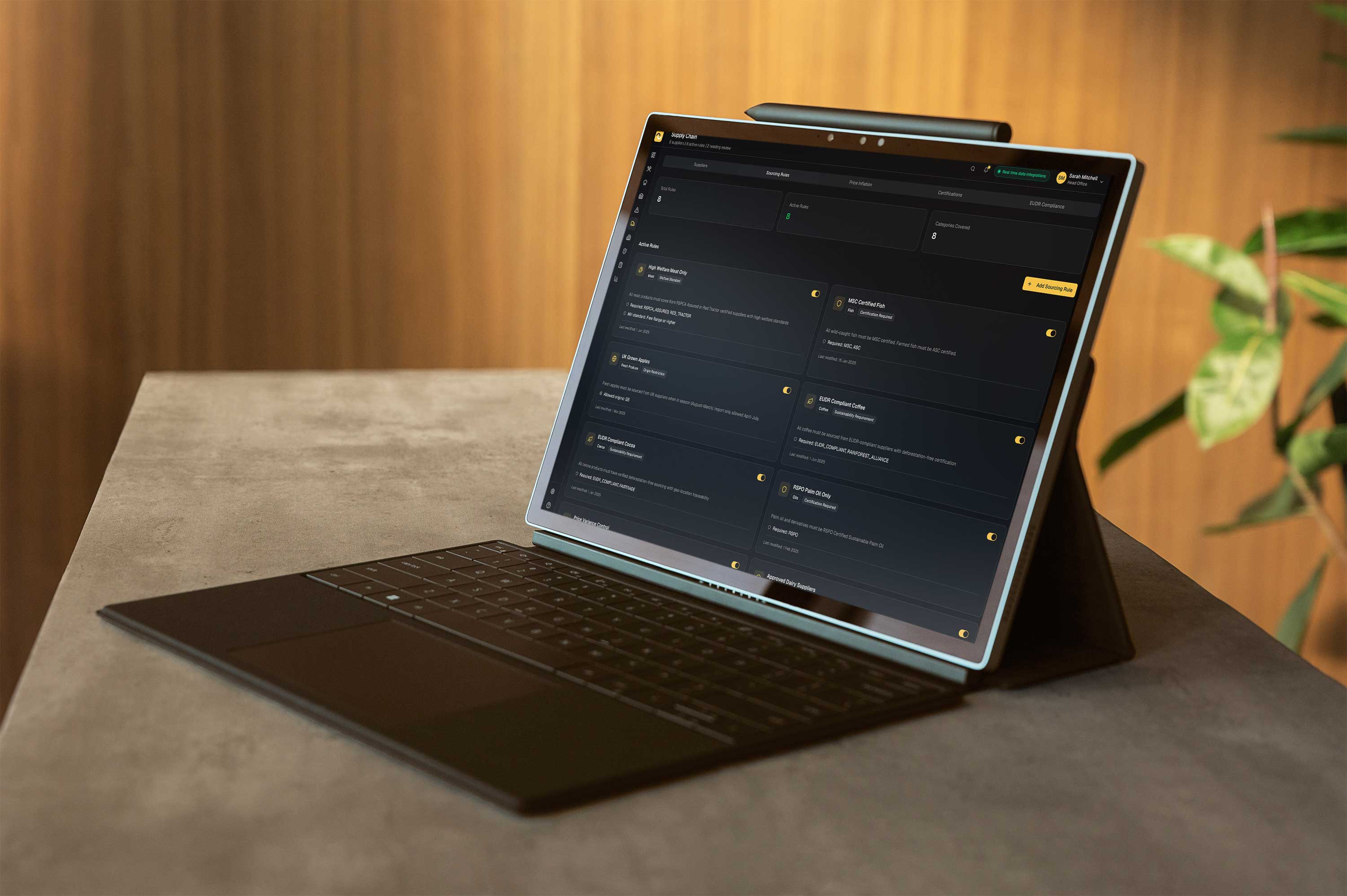
This is why we built Orderly fully modular and model-agnostic. The platform runs across multinational businesses with very different operating requirements, and it fits the structure each business runs today or is moving towards.
What that looks like in practice
The platform integrates natively with Oracle and SAP ERPs. It slots into your existing enterprise infrastructure without disruption, which matters because a restructure is exactly the wrong moment to rip out core systems.
Operators who need full P&L management run it through the platform. Businesses that want end-to-end control can run partial or full procure-to-pay through it, from requisition to settlement.
Orderly's distribution technology is typically licensed at an organisational level, rather than charging separately for every module you switch on. You use the capabilities your operation needs, leave the rest, and expand as requirements change.
Our store execution platform is licensed per store, so costs scale with the size of the operation rather than the number of features used.
Together, this gives multinational operators the flexibility to run a regional pilot in one market, a full procure-to-pay deployment in another, and different operating models within the same country, all on the same platform and with consistent visibility.
That means a regional pilot in one market can run alongside a full procure-to-pay deployment in another, on the same platform and with the same visibility, without creating a patchwork of additional module fees.
The outcome stays constant across every configuration. You see what is happening, you understand why, and you act earlier, whichever model executes the physical work.
Why Visibility Beats Structure
Most firms manage their supply chains by watching only the first-tier supplier and the first-tier customer. Research covering thousands of firm relationships shows this leaves them with almost no true supply chain visibility beyond that first tier. A model change does nothing to fix this. A cross-model intelligence layer does.
The regulatory direction makes this urgent rather than optional. Frameworks like the EU's Corporate Sustainability Reporting Directive demand granular data on emissions, traceability and due diligence across multi-tiered networks. For organisations that remain in scope, regulation still increases the need for reliable emissions, traceability and value-chain data. And even where reporting is not mandatory, customers, investors and internal sustainability teams increasingly expect the same visibility.
The commercial case is equally direct. Organisations applying AI and integrated ERP report 40 to 60% better visibility, 15 to 25% lower carrying costs, and total supply chain cost reductions of 25 to 40% among mature adopters. Those gains come from intelligence applied across the operation. They do not depend on which logistics model sits underneath.
The Question to Take Into Your Next Restructuring Review
If you are weighing a move to 4PL right now, we are not going to tell you it is wrong. For some operations it is the right call. For others a hybrid structure protects control where control creates value.
Our advice is to change the order of the decision.
First, establish the intelligence layer. Get forecasting accuracy, site-level visibility and cross-model data flow in place. Then choose your structure, knowing you will keep full visibility and control whichever way you go, and knowing you can change your mind later without starting again.
Structure follows intelligence. Businesses that get this sequence right reduce waste, protect margin and meet their sustainability commitments through prediction rather than promises.
Right now, across thousands of kitchens and depots, decisions encoded into forecasting logic are preventing waste no one will ever see. That is what the intelligence layer does. The model underneath it can change as often as your business needs it to.
If you are reviewing your supply chain structure this year, we are happy to walk through how the platform fits the model you run today and the one you are considering. Bring your hardest market. That is usually where the conversation gets useful.


.svg)




.svg)

.svg)
.svg)