


Your Direct Sourcing Process Is a Single Point of Failure
Your procurement team is making critical decisions with incomplete information.
When geopolitical tension disrupts oil supplies, when tariffs shift overnight, when a key supplier flags financial distress, your response speed depends entirely on how quickly you can access accurate data about your sourcing relationships.
Most organisations cannot respond quickly enough.
21% of supply chain leaders operate without real-time visibility into disruptions affecting their suppliers. Another 18% cannot identify which suppliers pose the highest regulatory or compliance risk. When crisis hits, these gaps become operational paralysis.
The problem is structural. Your direct sourcing process was built for a different era. Manual workflows, fragmented data sources, and quarterly risk reviews made sense when supply chains moved predictably. They create dangerous bottlenecks now.
The Manual Procurement Trap
Eight in ten procurement requests still happen through emails and spreadsheets. This is not a minor inefficiency. It is a fundamental constraint on your ability to act.
Consider what happens when you need to evaluate alternative suppliers during a disruption. Your team must:
- Pull data from multiple disconnected systems
- Manually verify supplier compliance status
- Check financial health indicators across scattered sources
- Cross-reference regulatory requirements by region
- Assess capacity and lead times through email chains
- Compile everything into a format decision-makers can use
By the time you have a complete picture, the opportunity has passed. Your competitor with integrated data made the decision three days ago.
42% of executives cite lack of real-time data as their main limitation when responding to disruption. The constraint is not talent or budget. It is infrastructure.
Manual processes do not just slow you down. They introduce error at every handoff point. Data gets outdated between collection and analysis. Context gets lost in translation between systems. Risk signals get buried in noise.
The Visibility Problem Extends Beyond Tier One
You probably have reasonable visibility into your direct suppliers. The risk lives deeper in your supply chain.
93% of executives report high confidence in their overall supply chain oversight. Those same executives identify Tier 2 and Tier 3 suppliers as their most critical blind spots.
This gap matters more now than it did five years ago. Global supply chain disruptions cost businesses $184 billion annually, and 65% of companies face at least one bottleneck in their supply chain according to recent data.
When a Tier 2 supplier experiences financial distress, you often learn about it when your Tier 1 supplier cannot fulfil an order. By then, your options are limited and expensive.
The semiconductor industry provides a stark example. 46% of semiconductor companies still rely on manual spreadsheets to track supply chain risks. These are sophisticated organisations with significant resources. They understand the problem. They have not solved it because the infrastructure required represents a fundamental change in how procurement operates.
Geopolitical Volatility Demands Different Infrastructure
The external environment is not stabilising. It is becoming more volatile.
72% of trade professionals identified U.S. tariff volatility as the most impactful regulatory change in 2026, up from 41% the previous year. This is not a temporary spike. It reflects a sustained shift towards trade policy as a tool of geopolitical competition.
Your procurement function needs to operate in an environment where:
- Tariff structures change with minimal notice
- Export controls expand unpredictably
- Supplier access to key materials becomes politicised
- Regional conflicts disrupt established logistics routes
- Regulatory compliance requirements diverge across markets
41% of high-tech supply chain professionals identify geopolitical volatility and export controls as their greatest risk concern. Another 39% list fluctuating international tariffs as a high-priority risk factor.
Manual processes cannot keep pace with this rate of change. Quarterly risk reviews become outdated before they are distributed. Spreadsheet-based tracking cannot incorporate real-time regulatory updates across dozens of jurisdictions.
You need infrastructure that updates as conditions change.
The Strategic Case for Modernisation
Organisations that digitise procurement achieve their cost savings targets 96% of the time. Those relying on manual processes hit their targets 80% of the time.
The difference is not marginal. It compounds across every sourcing decision, every supplier relationship, every response to market volatility.
Companies implementing digital procurement solutions report 30% reduction in procurement costs and 40% increase in procurement efficiency. The return on investment for e-procurement has been calculated at 720%.
These are not theoretical projections. They reflect measured outcomes from organisations that replaced manual workflows with integrated data systems.
The efficiency gains come from eliminating repetitive administrative work. The cost savings come from better visibility into spending patterns and supplier performance. The strategic value comes from faster, more confident decision-making during disruption.
Organisations with efficient procurement processes report 15-25% cost savings and 40% faster time-to-market for new initiatives compared to those with fragmented approaches.
Speed matters. When you can evaluate and onboard alternative suppliers in days rather than weeks, you reduce exposure to single-source risk. When you can model tariff scenarios in real-time, you make better decisions about where to source components.
From Reactive Monitoring to Predictive Intelligence
The next phase of procurement infrastructure is not just faster access to current data. It is predictive visibility into emerging risks.
70% of organisations now prioritise supply chain visibility and resilience as key areas for technological investment. This investment is shifting from basic monitoring tools towards systems that integrate real-time data with AI-driven scenario planning.
Predictive risk intelligence identifies threats before they materialise into disruptions. It monitors financial indicators, regulatory changes, geopolitical developments, and operational performance across your entire supplier network.
When a supplier shows early warning signs of financial stress, you receive an alert whilst you still have time to develop alternatives. When regulatory changes are proposed that would affect your supply chain, you can model the impact before the rules take effect.
This is not speculation about future technology. These capabilities exist now. The barrier to adoption is not technical feasibility. It is organisational readiness to change how procurement operates.
What Modernisation Actually Requires
Moving from manual processes to integrated intelligence requires three foundational changes:
Unified data architecture. Your supplier information, compliance documentation, performance metrics, financial data, and risk indicators need to exist in a single system. Not connected systems. Not integrated dashboards pulling from multiple sources. One source of truth that updates in real-time.
Automated monitoring. Manual risk reviews happen quarterly because they require significant effort. Automated systems monitor continuously. They flag anomalies as they emerge. They track regulatory changes across jurisdictions. They update supplier risk scores based on multiple data streams.
Decision support that operates at the point of action. The system needs to surface relevant information when procurement teams are making decisions. Not after. Not in a separate report. At the moment the decision is being made.
These changes represent significant investment. The cost of not making them is higher.
How Orderly Delivers Procurement Intelligence at Scale
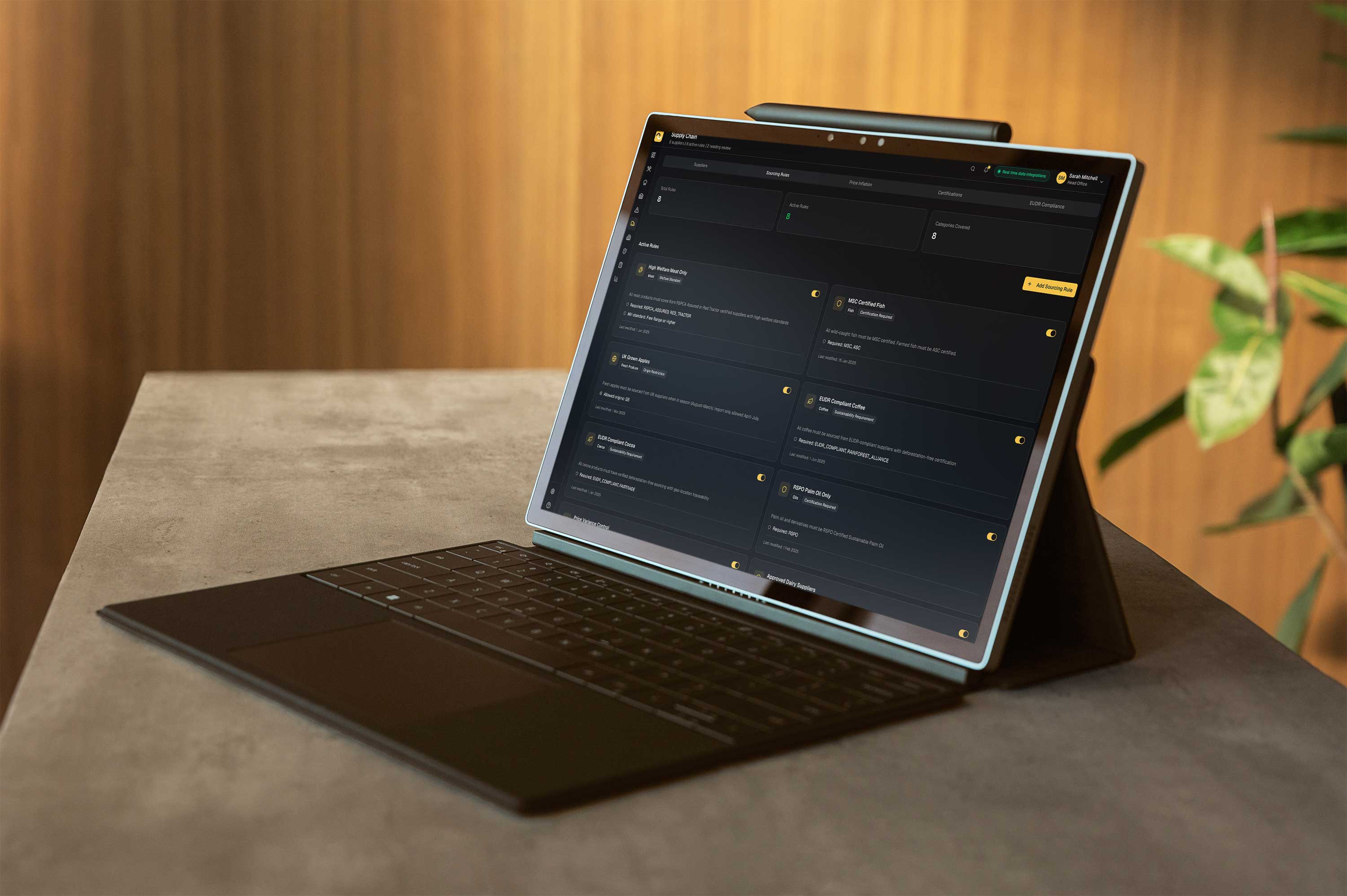
Orderly's supplier management and risk platform was built to solve exactly this problem.
The system provides a unified view of your entire supplier network with continuous risk monitoring that operates across multiple data streams. Financial indicators, compliance status, geopolitical developments, and operational performance are tracked in real-time, not quarterly.
The AI overlay is not generative theatre. It is intelligence built from platform data across thousands of sites and purchasing decisions. The system learns from patterns in your actual operations, flagging anomalies before they become disruptions and surfacing risk signals that manual reviews miss.
For large franchise brands and disparate purchasing organisations, this matters differently.
When your brand operates through franchisees, contract caterers, or multi-site QSR networks, procurement control becomes brand risk. A single location sourcing from a non-compliant supplier can create reputational damage that affects the entire organisation.
Orderly gives you back control without removing operational flexibility. Franchisees and site-level teams can source within defined parameters whilst head office maintains live visibility into supplier performance, compliance status, and emerging risks across the entire network.
The platform shows you which sites are ordering from which suppliers, what compliance documentation is current, where cost anomalies are appearing, and which supplier relationships present elevated risk. You act earlier because you see earlier.
This is not about centralising all procurement decisions. It is about making decentralised procurement visible and manageable at scale. The intelligence layer sits between autonomy and anarchy.
When geopolitical disruption affects a key supplier, the system immediately identifies which sites are exposed, what alternative suppliers meet your requirements, and how quickly you can execute the switch. The decision still requires human judgement. The data arrives in minutes, not days.
Only 27% of companies have successfully introduced AI into their procurement or supply chain functions. 14% of organisations still lack any digital roadmap. This gap represents opportunity for organisations that move decisively.
Procurement as Strategic Infrastructure
Trade departments are no longer an execution layer. They are becoming a strategic layer of the enterprise.
The organisations that recognise this shift are treating procurement modernisation as infrastructure investment, not software purchase. They are allocating budget accordingly. They are involving senior leadership in the transformation. They are measuring success by decision quality and response speed, not just cost reduction.
Managing supplier risk is no longer the exclusive domain of audit teams. It sits at the centre of strategic procurement. It determines your competitive resilience in a volatile global market.
Your current direct sourcing process was adequate for stable conditions. Those conditions no longer exist. The bottlenecks that were merely inefficient have become operational liabilities.
You can continue operating with fragmented data and manual workflows. Your competitors are not.
The question is not whether to modernise your direct sourcing infrastructure. The question is whether you modernise before the next disruption exposes the cost of delay.


.svg)





.svg)

.svg)
.svg)